
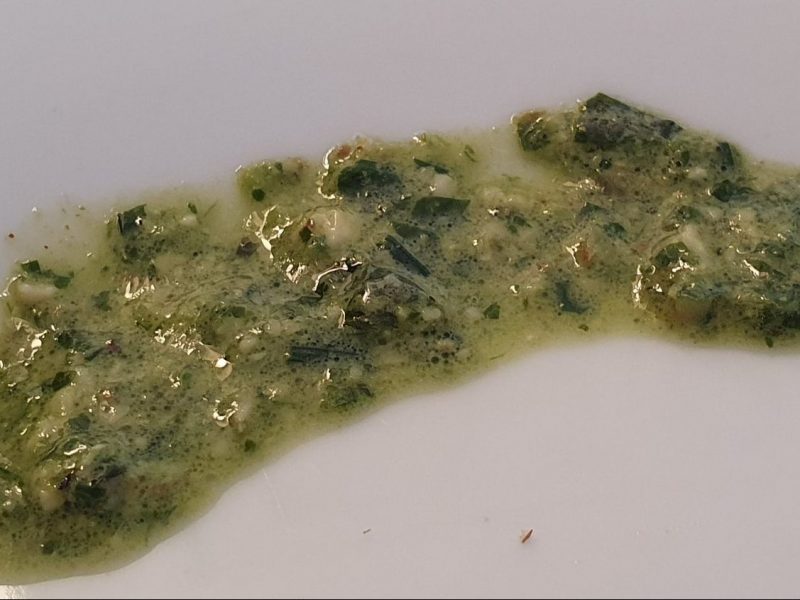
Wild garlic pesto is a popular pesto that you may have heard already about. Here we present an upgraded recipe with three wild plants: wild garlic (Allium ursinum), crow garlic (Allium vineale), and garlic mustard (Alliaria petiolata). All these plants grow in spring in a similar environment, quite often next to each other. Wild garlic has a rather mild garlic taste, crow garlic is very similar to chives, and garlic mustard tastes like mustard greens with a hint of garlic and this last one will spice up your pesto. You can use wild pesto in multiple ways: as a bread
Category: Recipes

Gyoza is a kind of Japanese fried-steamed dumpling. Traditionally, they are filled with meat, mushrooms, and cabbage. Here we present a wild version with two mushrooms and late-spring greens: wild garlic (Allium ursinum), narrow-leaf plantain (Plantago lanceolata), arugula (Eruca vesicaria), and rapeseed kale (Brassica napus L.). From left wild garlic (Allium ursinum), narrow-leaf plantain (Plantago lanceolata), arugula (Eruca vesicaria), and rapeseed kale (Brassica napus L.) Four spring greens perfect for mushroom gyoza

Cleavers (Galium aparine) is known as a sticky plant that might not be pleasant to eat. You can use its leaves and stems to make an infusion for tea or for a smoothie base. It is in the same family as coffee (Rubiaceae). Its roasted seeds can be used as a coffee substitute, they even contain caffeine. For this smoothie for the wild ingredients, we use a cleavers’ (Galium aparine) infusion as a base and sorrel (Rumex acetosa) and Japanese knotweed (read more Reynoutria japonica) as the main aromatics for a pleasant acidic kick. To give the smoothie more body
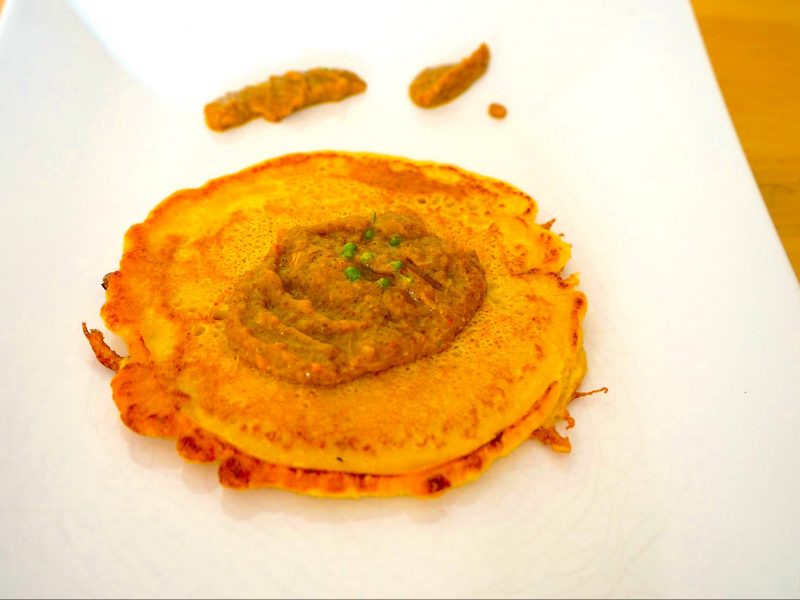
Japanese knotweed (Reynoutria japonica) is both botanically and culinary closely related to rhubarb. In Japan, it is categorized as “sansai” which translates to mountain vegetables. It is also considered as one of the worst invasive species worldwide as its deep strong roots which are hard to remove are capable of destroying infrastructure. In the kitchen the stems can be used in similar ways as rhubarb as long as its harvested when the stems are not too hard and fibrous. This is in early spring. Both rhubarb and Japanese knotweed contain oxalic acid which is not too healthy but as long

The two stars of this recipe are ground elder (Aegopodium Podagraria) and Japanese knotweed (Reynoutria japonica). Ground elder was spread around Europa by Roman soldiers. They use it as a spice. Nowadays, this plant is considered as an invasive weed. Despite being a nuisance to gardeners, ground elder has medical properties and can help treat gout and arthritis. We described Japanese knotweed here. Ground elder (Aegopodium Podagraria) leaves (left) and blooming plant (right). The inspiration for this soup was a rhubarb-carrot soup recipe. We replaced rhubarb with Japanese knotweed and carrot with ground elder. To add sweetness we used sweet potatoes and to

Hogweed (Heracleum sphondylium) was historically used as food, most notably as the foundation of the Eastern European soup known today as borscht. Borscht also happens to be the common name of this plant in Slavic languages, although hogweed is not used in the modern-day version of the soup. A variety of hogweed known as Persian hogweed (Heracleum persicum) is used as a spice in Persian cuisine. The common name of hogweed in English comes from its application as forage for hogs. When picking hogweed care should be taken to not confuse it with its bigger counterpart giant hogweed (Heracleum mantegazzianum).

In this recipe, we used Chicken of the woods (Laetiporus Murill) as the star of a Vietnamese Bahn mi. Bahn mi is a French-inspired sandwich made of baguette-style bread usually with pickled carrot and daikon radish, mayonnaise, and meat, tofu, or seafood. As a wild garnish, we used dandelion (Taraxacum officinale) and garlic mustard (Alliaria petiolata). For more information about Chicken of the woods check our Chicken of the woods nuggets recipe.

Chicken of the woods (Laetiporus Murill) is a mushroom resembling chicken as its name suggests. This mushroom comes out in spring and with its distinctive look is virtually impossible to mix up with any other mushroom. It grows on dying or dead trees. Nuggets made of this mushroom are very hard to distinguish from real chicken! The mushroom should be harvested when young before the bottom side developed many pores. If the mushroom is too old the taste can become acidic and the structure too hard. At that stage, the mushroom can still be used to dry out and grind
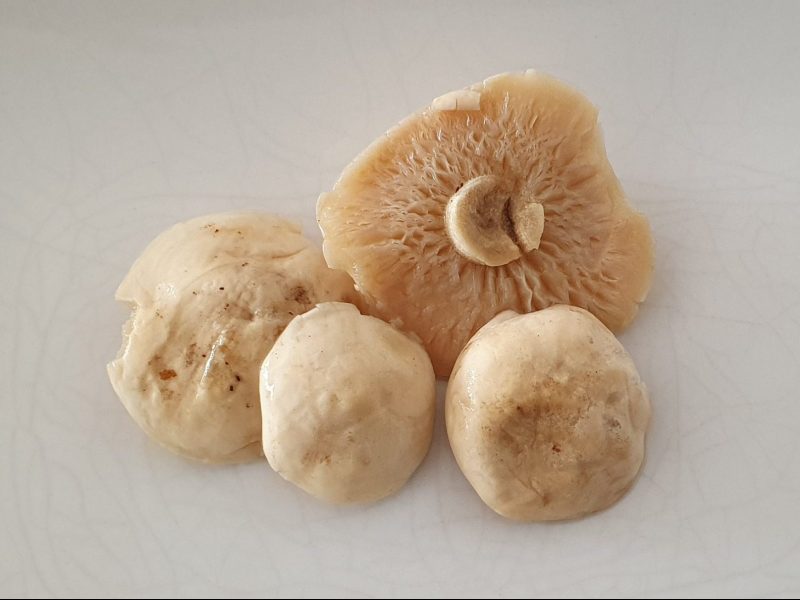
Fermenting mushrooms is a popular way to preserve mushrooms in Slavic countries. Mushrooms prepared this way can be used in a salad or on bread. The liquid, left over after fermentation, can be used as a vegan fish sauce. For this recipe, we used St. George mushroom (Calocybe gambosa). The St George mushroom is one of the first gilled mushrooms to appear in the spring. Historically it appeared around St George day on 23th April but in current days can be found weeks earlier. This mushroom is one of the few mushrooms that can be consumed raw. Its raw taste